Warehouse Assessment: How to Read a Building in 4 Hours

A good warehouse assessment starts on the floor, not in a spreadsheet. After 25 years of running buildings from a few hundred to a few thousand associates, I can usually tell where a site is losing money within four hours of walking it. The data confirms it later. It rarely surprises me.
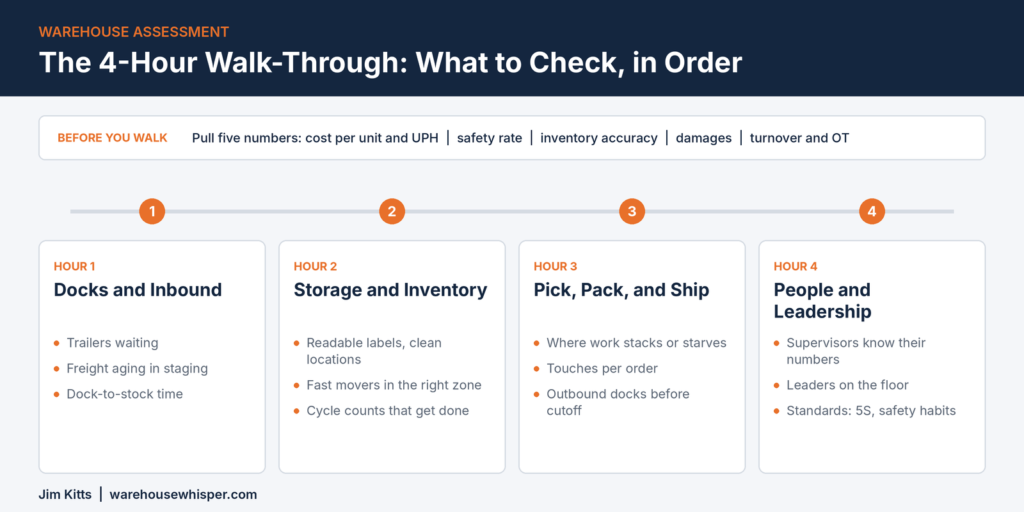
Here is the order I use, and what I’m looking for at each stop.
Before You Walk: Pull Five Numbers
Get these first so you know what the floor should be telling you:
- Cost per unit and units per labor hour
- Safety incident rate
- Inventory accuracy
- Damages and cargo loss
- Turnover and overtime
You are not analyzing yet. You are forming a question. If UPH is flat but overtime is climbing, something upstream is broken. Go find it.
Compare them against industry benchmarks like WERC’s DC Measures report.
Hour 1: Docks and Inbound
Start at the doors. Inbound problems hide everything downstream.
- How many trailers are waiting, and for how long?
- How much freight is sitting in staging, and how old is it?
- Is receiving working to a plan, or reacting to whoever shows up?
- How long from dock to stock?
If product is in the building but not in a location, your pickers are already losing time. They just don’t know why yet.
Hour 2: Storage and Inventory
Walk the aisles and look at locations, not products.
- Are labels readable and locations consistent?
- Are fast movers in the golden zone, or buried?
- Is there mixed, overstocked, or orphaned product?
- Do cycle counts get done, and what happens when they find a variance?
Inventory accuracy is a discipline problem more than a technology problem. A clean building with average systems beats a messy one with great ones.
Hour 3: Pick, Pack, and Ship
Now watch the work move.
- Where does product stack up, and where does it starve?
- How many touches does an order take?
- Are cutoffs real, or negotiable?
- How do the outbound docks look an hour before the carrier arrives?
Stand at one station for fifteen minutes and time it yourself. You will learn more than from a week of reports.
Hour 4: People and Leadership
This is where the real answer is.
- Do supervisors know their numbers without looking them up?
- Do associates know what good looks like today?
- Is leadership on the floor, or on the phone?
- Does anyone stop what they’re doing when a safety issue shows up?
Housekeeping, safety habits, and how people talk to each other tell you how the building is run. In my experience, sloppy standards almost always hide leadership gaps.
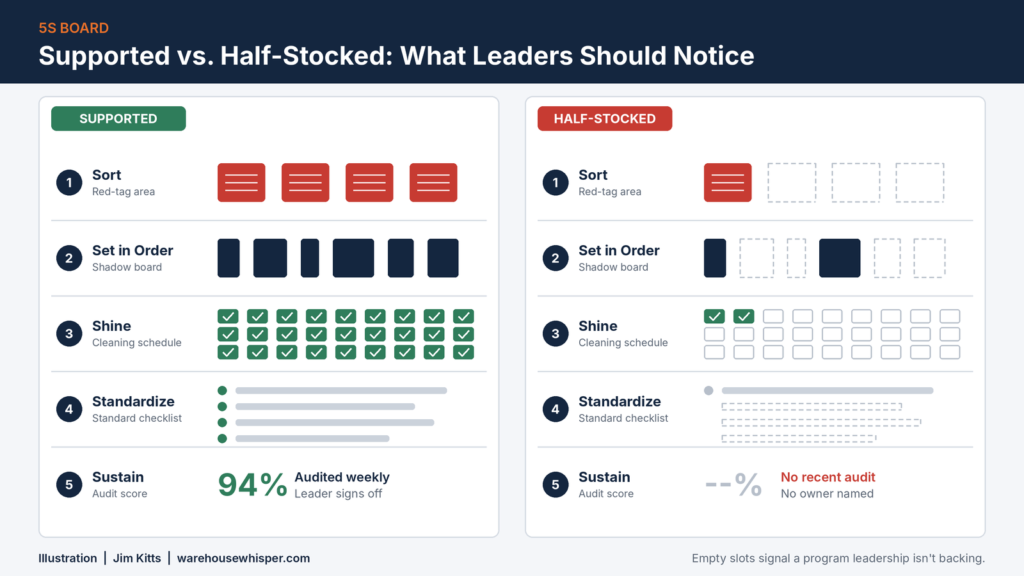
I often walk into a building and find half-stocked 5S boards, with missing tools, supplies, or labels. That slows the cleaning process, but the bigger problem is what it signals: a program that was launched and never supported. If that sounds like your building, start with my 5S methodology post and get it back on track.
What the Walk Tells You
After four hours, you are looking for patterns, not a list of 40 problems:
- Standards are loose: expect errors, damages, and rework.
- Flow is blocked: expect overtime and missed cutoffs.
- Leaders aren’t visible: expect turnover and safety issues.
- Data doesn’t match the floor: expect bad decisions made on good-looking reports.
Pick the two or three issues that explain most of the cost. Everything else can wait.
Turn It Into a Plan
A walk-through only matters if it produces action. For each finding, write down:
- What you saw
- What it is costing, in labor, errors, or service
- The first fix, and who owns it
- The metric that proves it worked
Keep it to one page. If it takes ten pages to explain, nobody will fix it.
Conclusion
A warehouse assessment doesn’t need a six-week study to find the main problems. Start with five numbers, walk the building in order, and look for patterns. The floor tells you the truth faster than the report does.
If you want a second set of eyes on your building, see the one-week operations review. For more on where margin leaks out of fulfillment, read e-commerce profits.
FAQ
How long does a warehouse assessment take?
A first read of a building takes about four hours on the floor, plus time to review the data. A full improvement plan takes longer.
What should I look at first in a warehouse assessment?
Start with inbound: docks, staging, and dock-to-stock time. Problems there show up in every step after.
Do I need data before I walk the warehouse?
Pull five numbers first: cost per unit, UPH, safety rate, inventory accuracy, and turnover. They tell you what to look for, but the floor confirms it.